The Range Hood Is the Focal Point Now
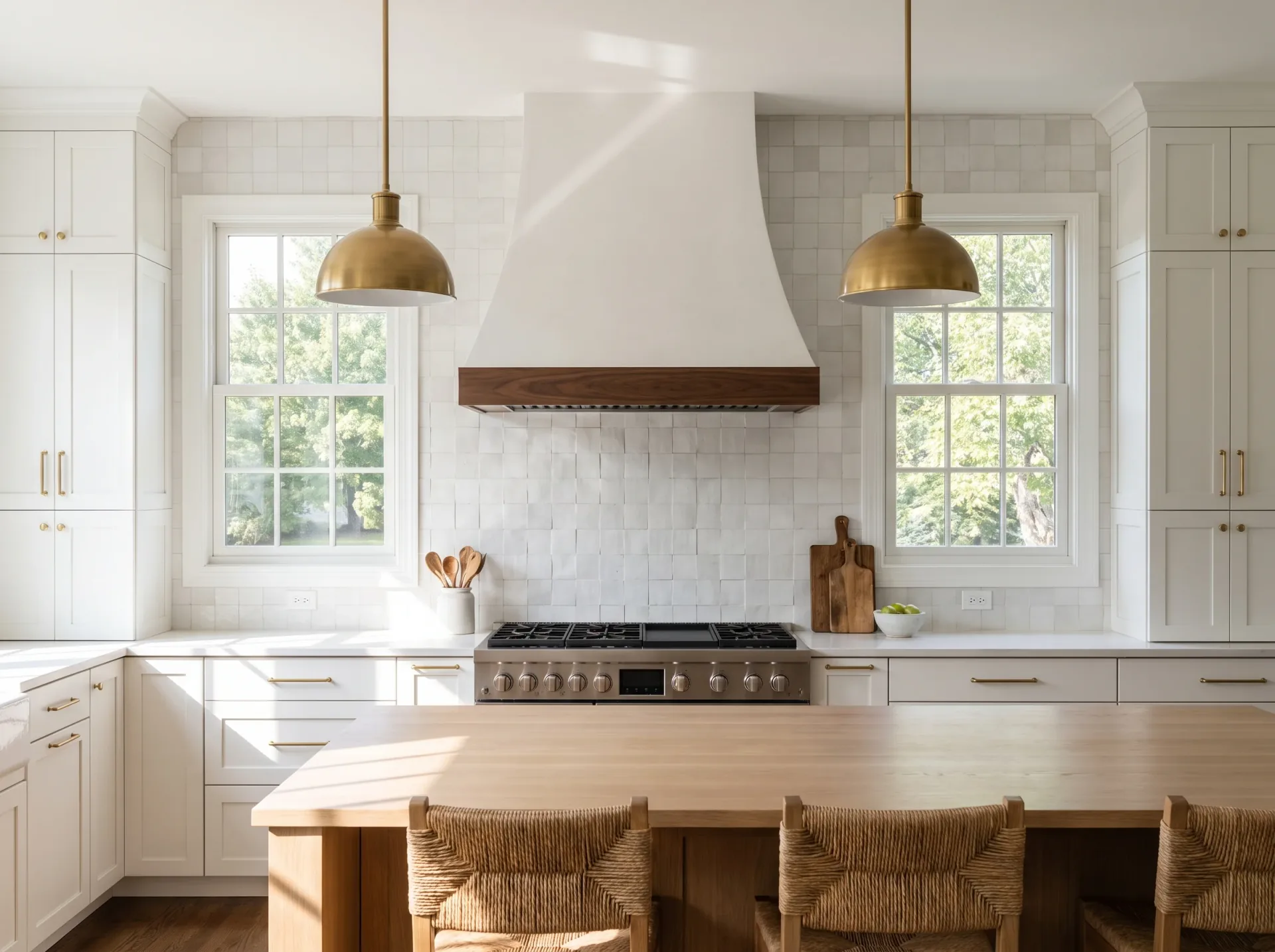
Walk into almost any kitchen we have finished in the last two years and your eye goes to the same place: the wall behind the range. The hood sits in the middle of it, the tile runs up around it, and the cabinets step back to let it breathe. That is not an accident. Somewhere in the last decade the range hood stopped being a stainless box tucked under a cabinet and became the piece of architecture a kitchen is organized around, the way a fireplace organizes a living room. Clients now arrive with a hood photo before they have a cabinet color. So here is how we think about the three families of hoods, the wall they live on, and the part nobody photographs: the duct.
A plaster hood reads as architecture, not appliance

A wood hood over herringbone tile from one of our recent kitchens
Wood: Warm and Custom
A wood hood is cabinetry, built by the same shop that builds your doors, in the same finish or a deliberate contrast. It can be painted to disappear into the uppers, stained to match an island, or wrapped in white oak to be the one warm element in a white kitchen. Because it is millwork, its proportions are entirely ours to set: a tapered chimney, a flat mantel-style shelf, a simple box with a thick crown. The hood in the kitchen above is stained to match the island so the two read as a pair across the room, which is the kind of move only a custom hood allows.
What wood cannot do is touch the heat. Every wood hood is a shell around a metal liner and blower, and the liner sets the real dimensions. Code and the blower manufacturer dictate the clearance between the cooktop and the bottom of the liner, usually thirty inches for gas, so the wood is sized from there. We also keep the wood off the backsplash by a hair, because tile and wood expand differently and a hard joint cracks the paint.
Plaster: Quiet and Sculptural
A plaster hood is the one clients point to most often right now. It is a framed and drywalled form, skimmed in smooth plaster or a limewash finish, and it reads as part of the wall rather than something hung on it. It suits kitchens where the tile is doing the talking, because a plaster hood has no grain, no hardware, and no edge detail to compete. It also suits tall ceilings, where a chimney that runs all the way up makes the room feel finished in a way a stub hood never does.
The trade-off is repairability and grease. A painted plaster hood is wipeable; a raw limewash finish is not, and it will show the cooking of a family with three kids over time. We seal them, and we talk honestly about which finish a household can live with. A plaster hood is also built in place, so it is harder to change your mind about later than a wood hood that unscrews from the wall.
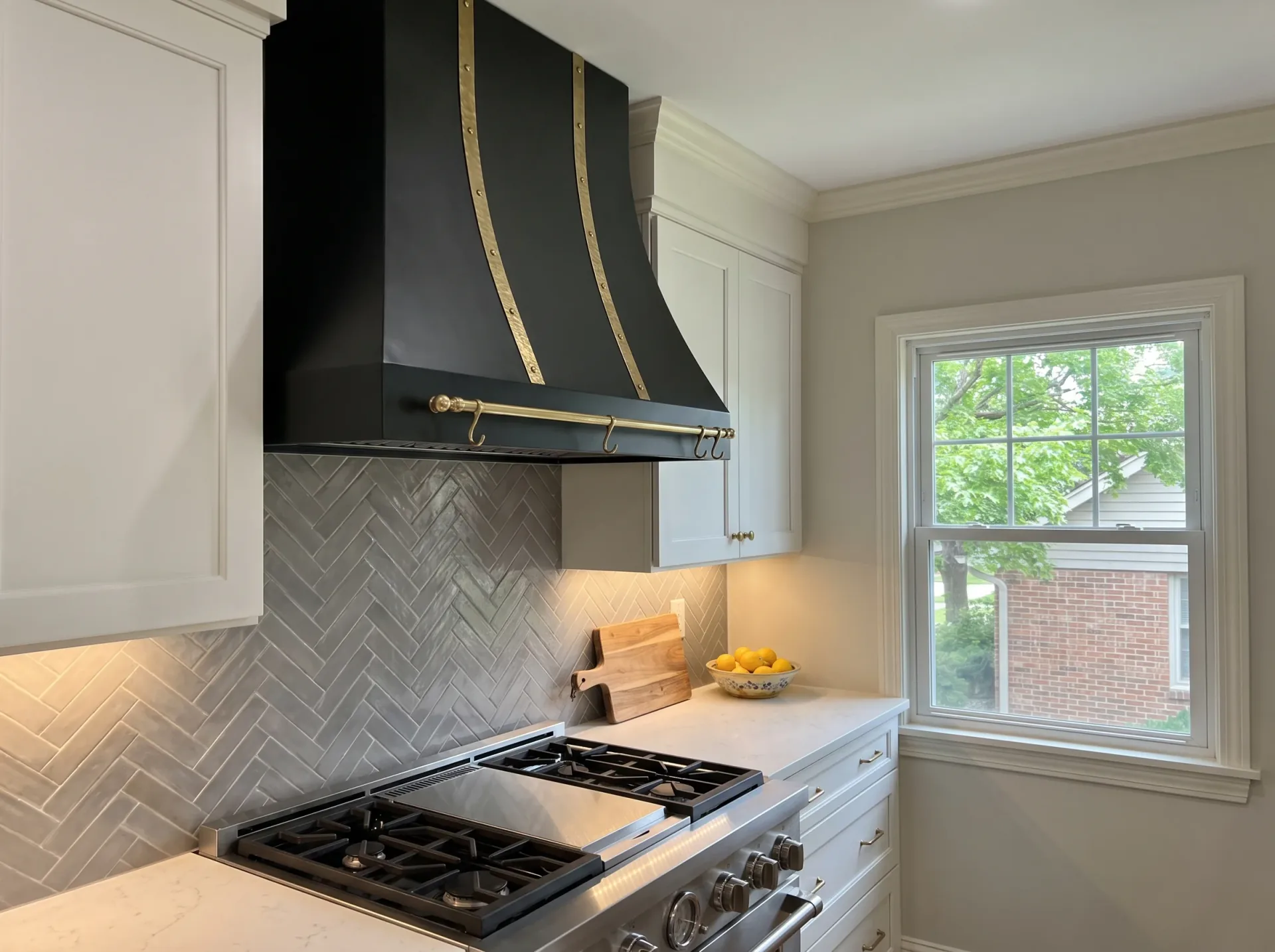
A metal hood with brass strapping brings the jewelry to the range wall
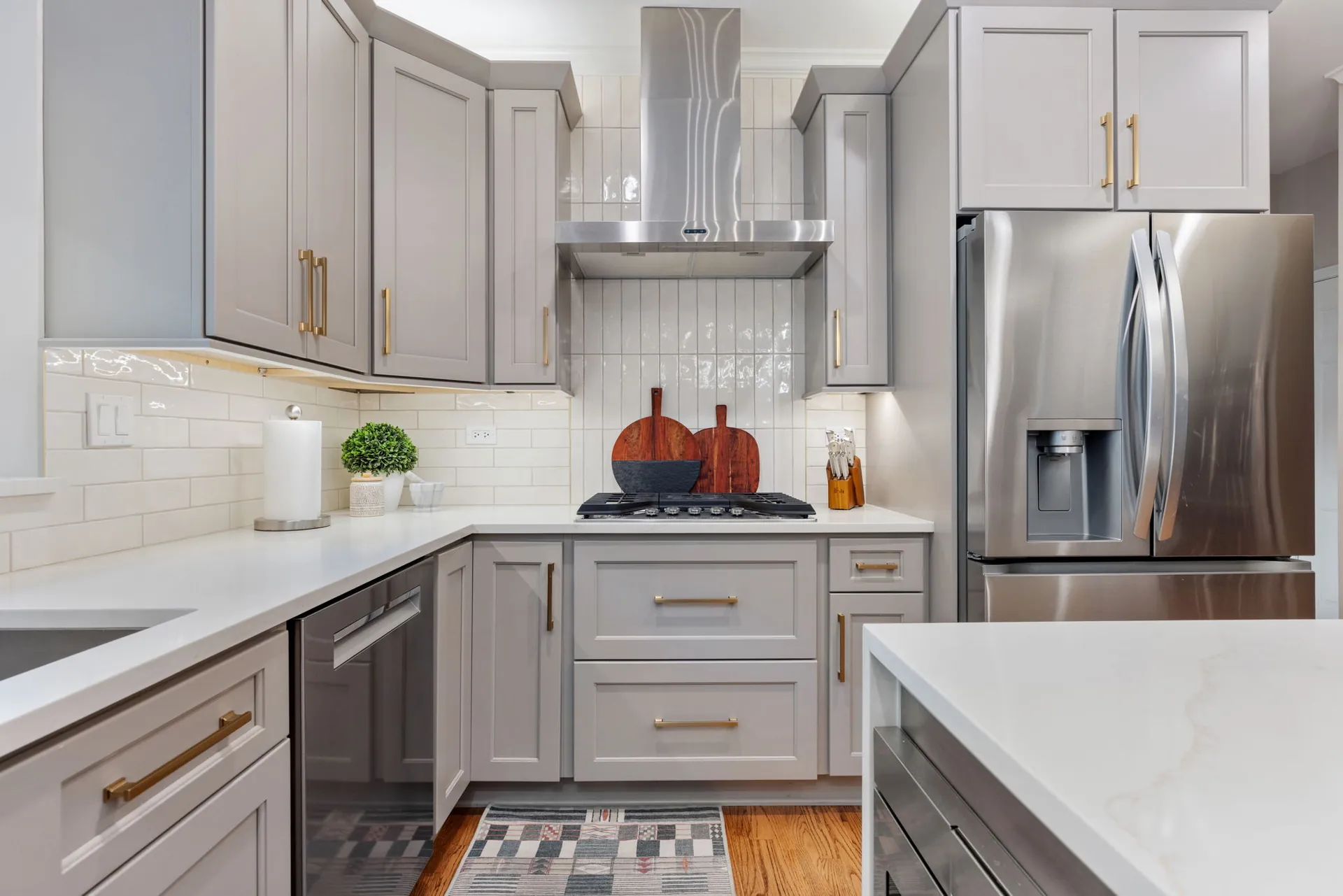
Stacked tile run to the ceiling gives a chimney hood its backdrop
Metal: The Statement
Steel, copper, zinc, and brass hoods are the ones that make a kitchen feel like a restaurant or a French country house, depending on the finish. They are fabricated, not built, and they arrive as one heavy piece. Matte black steel with brass strapping is the current favorite because it ties into black windows and brass hardware without competing with either. Copper and zinc develop a living patina, which some clients adore and some find alarming when the first fingerprints show up; we show samples that have been handled for a year before anyone commits.
Metal is the most expensive family and the longest lead time, often ten to fourteen weeks from a custom fabricator, so it has to be decided early in the kitchen schedule, not after the cabinets are ordered.
The Wall Behind It
A hood only works as a focal point if the wall behind it is treated as one surface. That means the backsplash runs from the counter to the ceiling behind the range, or at least to the top of the hood, rather than stopping at the bottom of the upper cabinets. It means the uppers on either side are symmetrical, or deliberately not, and it means the tile pattern is centered on the range, not on the wall, because the eye reads the range as the center. Herringbone, stacked, and vertical tile all work; the one thing we avoid is a busy tile under a busy hood. One of them should be quiet.
The Part Nobody Photographs
None of the above matters if the hood does not move air. A beautiful hood over a recirculating filter is a decoration, and a kitchen that smells like last night's salmon is not a luxury kitchen. Every hood we install vents outside, which in a two-story house means a duct through the cabinets and out the wall behind the range, or up through the second floor and roof. Where the duct goes decides where the hood can go, and we figure that out at the design stage, not at rough-in.
Blower size follows the range. A standard residential range is comfortable with four hundred to six hundred cubic feet per minute; a professional-style gas range wants more. And once a blower crosses four hundred, the code in most of our towns requires makeup air, a damper that lets fresh air in to replace what the hood pulls out, so the house does not backdraft the furnace or water heater. It is an unglamorous line item that we include every time, because the alternative is a hood that works beautifully and a house that does not.
Olive + Baxter is a design and build studio in Naperville with a cabinetry showroom at 535 S Washington St, Suite 7, where you can see wood, plaster, and metal hood samples in person next to the tile and the cabinet finishes they will live with. Explore our Kitchen Remodelling services or contact us to start with the range wall.